
 I have been really happy to spend again some time in Duncannon, a nice small village at the seaside where the sea lies just behind your garden fence and where it’s possible to watch the secret life of the sea. This time, it was mostly stormy, even when it wasn’t raining and when going on the beach, it was possible to feel how the wind is fighting with you and holding you back when you want to walk. But anyway, there were a lot of brave people walking their dogs or just wandering around despite the heavy wind. I tried to be among them and spent some time taking photos and listening to the song of the wind and struggling with the flying sand.
 There are lots of marvellous places around Duncannon and this time I had a chance to visit quite a lot of them. The village itself is also very nice with picturesque views, some pubs, locals and summer visitors, small shops and sandy beach. But if you drive a bit you can visit easily the Hook peninsula, and the nearby towns Waterford and Wexford, the last one has given the county its name too.
 I had been to Waterford before, but that time my stay was limited at the bus station, waiting for the bus that took us to Duncannon. This time, I was lucky to see the town twice, and try again this quite common way of travelling from one side of the river to the other. So it means that we just drove on the ferry, and after 5 minutes off again, and very soon we were in the centre of Waterford, where the Street Performers’ Festival took place. The first time when I saw this way of travelling, was when going to Cobh. This is something that we don’t have, but here it seems to be very common.

The Street Performer’s Festival, which is called SPRAOI Festival (pronounces /sprii/) means FUN in Irish. Reading the name doesn’t make any sense how to pronounce it, so it’s better to write it down to remind it. It seems that in the Irish language they are very generous with writing different letters into one words and it seems that just in case, they have written them always more than they are ever going to pronounce. That makes Estonian so easy-peasy, in spite of all its 14 cases, but at least we pronounce how we write.
 The centre of Waterford was very nice and the people who had come to see the performers didn’t mind the rainy weather. Fortunately, it wasn’t raining all the time and children could enjoy the performances. Especially cool was the drum band from Ireland which consisted of children in different ages and of their really enthusiastic teacher who encouraged them to play and act, what they did really good.
 As the big clouds arrived we didn’t stay for the fireworks and we were smart because it started to pour rain and I don’t know if they could carry out any fireworks with such a weather. I would definitely want to come back to Waterford and spend some more time there.
We visited also Wexford, but that was a short visit, just got a glimpse of the main shopping street, so I must come back there too, and probably I will.
 With a rainy day, we visited the most haunted house in Ireland – the Loftushall. It is said that the Devil himself had visited that place and put a hex on a daughter so that her ghost hasn’t found peace till now and haunts in the house. In the 90-s one boldfaced man started to run a hotel in the house but on one night all the guests and staff ran away without any explanations and left all their belongings into the house and never came back to take away a thing. After that, the house has been abandoned and no one had wanted to come to live there. Nowadays it’s a tourist place, where they make guided tours with ghosts jumping from around the corners and spooking the poor tourists who have willingly paid for getting scared. But it is said that the house decides on its own who can stay there and for how long time. It seemed that our stay was quite accepted because we didn’t meet any real ghosts but of course, we did our tour and went quickly away. Maybe the ghost has got used to the crowds and stays still in some hidden place 🙂

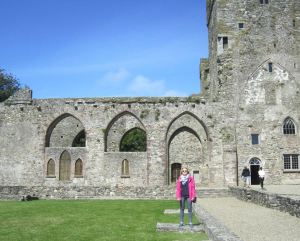
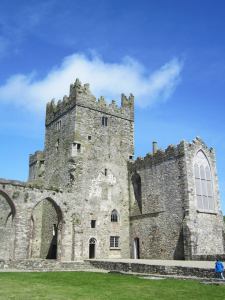 Tintern Abbey was founded in 1200 by Count William of Marshall and it got its name after the bigger namesake in Wales.
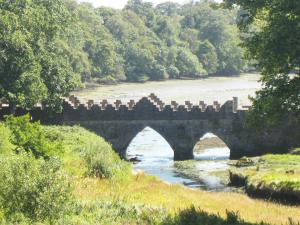 One of the vainest family members let to build such kind of a bridge, just only because its decorative and beautiful appearance. And especially decorative it looks seen through the upper window of the Abbey where our tour guide tells us stories about the Colclough family’s history. Yes, we are having a guided tour, so smart. The tour guide makes the place more alive, especially that she knows a lot about the characters and habits of every single person who has lived there.
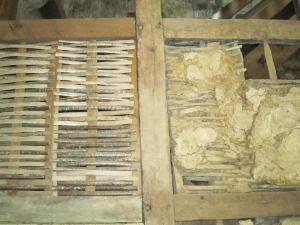 That’s how they built the walls during the old times – the blend between the lattice was made from so many different ingredients that the restoration workers of nowadays were not able to catch up on it. But at least they tried! And it’s possible to see the wall building process in different stages. The guide says that this filling made the walls warm keeping and let the stone breathe. Probably it will make sense for our school’s construction department 🙂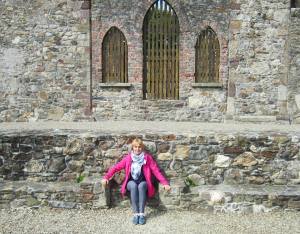
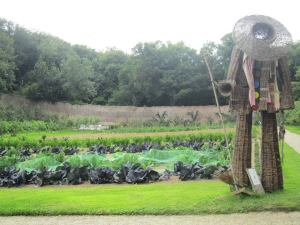 The little road that goes through the wood takes you to the Colclough Walled Gardens, which have been restored and trimmed recently and look quite nice. You need to buy a ticket again when entering the gardens, but I think they are collecting money for some more restoration work. The gardens are nice, full of flowers and there’s also an orchard part with vegetables and scarecrow which looks huge and decorative, probably not so decorative for the crows. In Estonia, we call these things not Scarecrows, but Scarepeas, instead, although they are meant to scare the crows, not the peas 🙂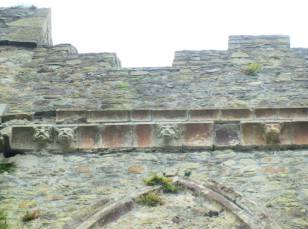
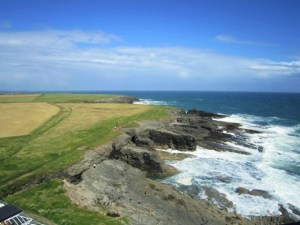 “By hook or by crook” is an English phrase meaning “by any means necessary”, suggesting that any means possible should be taken to accomplishing the goal. The phrase is very old, first recorded in the Middle English text Controversial Tracts by John Wyclif in 1380. I learned that phrase when we visited the Hook peninsula and Hook Lighthouse. I think that the weather was perfect to get the right feeling of the peninsula, surrounded by cliffs and the sea, ok, it could be of course a bit warmer, but the wind gave the special taste to that day. Despite the wind, we took the Lighthouse tour as well and climbed the top, where it was really stormy.
 The Hook Lighthouse is the oldest continuously working lighthouse in the world. Kõpu Lighthouse in Hiiumaa is the third, I looked it up afterwards because it looked so similar to ours. It is said that with better weather it could be possible to see the dolphins, but we were not so lucky and maybe it was too stormy even for the dolphins and they spent their time relaxing in some bay. It was a great experience to stand on the top of the lighthouse, almost unable to walk and totally unable to hear anything else but the sea and the wind. But that’s exactly what I came to see and hear here.







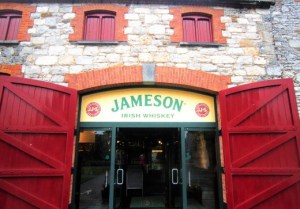 A trip to whiskey factory, that was meant to be a year before, was carried out now. I guess it was one of the rainiest weathers and so we had to pick something that will take us indoors. In that place, you again have to take a guided tour and at the end of the tour, when it’s possible to taste different whiskeys, you could get a Jameson Irish
 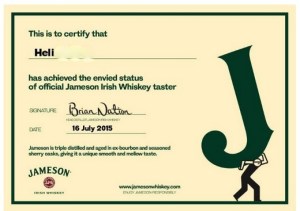 Congratulations! You toured, you tasted, and now you can tell the world. Thanks for visiting the home of Jameson and toasting over 230 years of history. Enjoy your Jameson Irish



 Dublin Accent