
Dún Laoghaire is a small suburban seaside town, located just 12 km’s from Dublin by train. Actually, it’s a part of Dublin and it takes about 15 minutes to reach it from the city centre but when you are already there, nothing reminds you the big and busy capital city and you feel yourself like in a real summer resort town. Long and nice promenade takes you along the seaside and calm and well-rested people are walking their dogs, riding their bicycles and strolling along the seashore, sitting on the benches and enjoying their 99 Flake ice-creams. Even the weather seemed to be totally different from the city weather and we had to take off our jackets and put on the sunglasses and of course, buy the 99 flakes at once.


I was wondering why do they still call them 99-s when they don’t cost 99p-s or there doesn’t seem to be any other connection with that number and so I had to google it. And the result was amazing – the ice-cream served in a cone with a Flake 99 is UK-s (and probably Irish) favourite ice-cream and I pretty much have to say that it’s my favourite ice-cream too for now. But calling them 99 has a long historical touch – the majority of ice-cream merchants in the 30-s were Italians and in the days of the monarchy, the Italian King had an elite guard consisting of 99 soldiers. After that everything elite or first class was called 99. That’s how they started to call them so. I also found that the Flake has to be 99 mm-s long and the cones had also cost 99 p-s in the past, but somehow I like the story of Italian elite the most. Now I know that my taste is elite 🙂


The name of the place is very hard for me to remember, especially the pronunciation but I am so used that the Irish names are the tough ones and when you learn it, it’s not difficult any more – /dun lieeri/, it sounds for me, and it means The Fort of Laoghaire. The high king of Ireland, Lóegaire mac Néill, chose this place as his sea base from where to carry out raids in the 5-th century. The town Dún Laoghaire dates from the 1820s and was called Kingstown at first. The two piers were founded in the 19-th century and the harbour is now one of the largest in the country. We picked the East Pier for our walk and after googling it came out to be the most popular and even used in some movies. The long walk ends at the old Lighthouse where you can also find a small cafe and the ice-cream parlour, selling the Flake 99, of course. The buildings on the pier reminded me a lot of our Haapsalu promenade, probably all the summer resorts have something in common 🙂


On that day Dún Laoghaire was hosting the Laser Radial Youth and Men’s World Championship and we saw thousands of small boats coming back to the harbour. The amount of them was unbelievable and they still kept arriving when we left.


The piers seemed to be also a favourite place for local guys who practised diving from the quay. That was a bit terrifying to watch, especially that the water didn’t seem to be too warm and not too clean either but this little matter didn’t stop the boys.


I have to say it was one of my most beautiful days here and Dublin still surprises me – you can find so many different sides of it and you never get bored. And seaside places are among my favourites anyway.
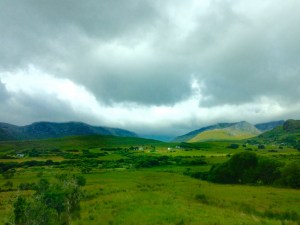 When getting nearer to Connemara, there were already more sheep than cows and none of them was lying. They all looked very colourful, of course, their real colour was white, but their heads were black and they all had painted red or blue stripes on their backs and they all had horns, even the girls 🙂 Estonian sheep never have horns, at least I have never seen them. The painted stripes have different meanings as our guide told us – they can mark the owner or if the sheep is sheared or not and probably something more that only the real sheep owners can understand.


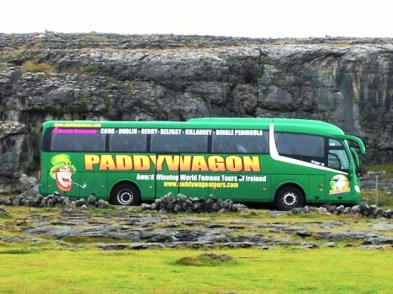
 Our tour guide is named John and he promises to speak as a real Dubliner and so he does all through the tour. He has thousands of jokes, stories and competitions, he predicts the weather, sings Galway girl, teaches us to swear politely and in an Irish way, using the word “feck”, which really doesn’t sound too rude, but a bit funny. And the least but not the last, at the same time he drives the big green Paddywagon bus with joyful elegance through all these narrow roads, and never loses his positive spirit, even not when we lose a couple on the Baby Cliffs. Ok, they just sat on the wrong bus and met us at the next stop, which means that at the same time there were more than one Paddywagon buses, to be honest, there were three.


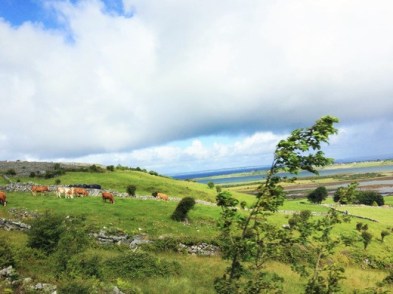 The landscape is green, so green and even greener, with some rocks and lambs, cows and small houses, sprinkled over all that greenness that make up the Emerald Island. The name Emerald Island is the perfect match to Ireland, if you haven’t seen it, you will never believe how many different shades of green are possible to find there. The stone fences seem to be here as popular as on Estonian Islands, so I am pretty sure about our same Viking ancestors.
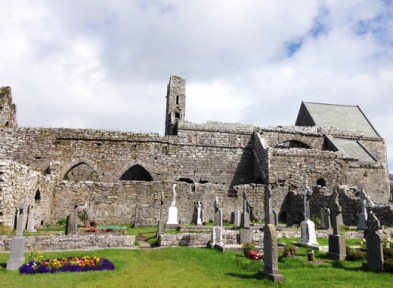 After twirling on the crooked roads that go up and down, back and forth, we end at the ruins of Corcomroe Abbey, a place where the Cistercian monks used to live in the 13th century. The abbey is located in Cleare County and is made of limestones, again something familiar. The views under the abbey vaults are nice, green and bumpy, but the big dark clouds are following us and when we are running on the bus it rains already. One of the Irish kings was buried under the abbey and lots of other noble and not so noble persons into the small graveyard that surrounded the abbey. Someone asked the guide if nowadays the graveyard was used and in which reasons you could be buried there. The guide answered that the only reason for that was to be dead (and of course preferably local, I guess).


 I have been really happy to spend again some time in Duncannon, a nice small village at the seaside where the sea lies just behind your garden fence and where it’s possible to watch the secret life of the sea. This time, it was mostly stormy, even when it wasn’t raining and when going on the beach, it was possible to feel how the wind is fighting with you and holding you back when you want to walk. But anyway, there were a lot of brave people walking their dogs or just wandering around despite the heavy wind. I tried to be among them and spent some time taking photos and listening to the song of the wind and struggling with the flying sand.
 There are lots of marvellous places around Duncannon and this time I had a chance to visit quite a lot of them. The village itself is also very nice with picturesque views, some pubs, locals and summer visitors, small shops and sandy beach. But if you drive a bit you can visit easily the Hook peninsula, and the nearby towns Waterford and Wexford, the last one has given the county its name too.
 I had been to Waterford before, but that time my stay was limited at the bus station, waiting for the bus that took us to Duncannon. This time, I was lucky to see the town twice, and try again this quite common way of travelling from one side of the river to the other. So it means that we just drove on the ferry, and after 5 minutes off again, and very soon we were in the centre of Waterford, where the Street Performers’ Festival took place. The first time when I saw this way of travelling, was when going to Cobh. This is something that we don’t have, but here it seems to be very common.
 The centre of Waterford was very nice and the people who had come to see the performers didn’t mind the rainy weather. Fortunately, it wasn’t raining all the time and children could enjoy the performances. Especially cool was the drum band from Ireland which consisted of children in different ages and of their really enthusiastic teacher who encouraged them to play and act, what they did really good.
 As the big clouds arrived we didn’t stay for the fireworks and we were smart because it started to pour rain and I don’t know if they could carry out any fireworks with such a weather. I would definitely want to come back to Waterford and spend some more time there.
 With a rainy day, we visited the most haunted house in Ireland – the Loftushall. It is said that the Devil himself had visited that place and put a hex on a daughter so that her ghost hasn’t found peace till now and haunts in the house. In the 90-s one boldfaced man started to run a hotel in the house but on one night all the guests and staff ran away without any explanations and left all their belongings into the house and never came back to take away a thing. After that, the house has been abandoned and no one had wanted to come to live there. Nowadays it’s a tourist place, where they make guided tours with ghosts jumping from around the corners and spooking the poor tourists who have willingly paid for getting scared. But it is said that the house decides on its own who can stay there and for how long time. It seemed that our stay was quite accepted because we didn’t meet any real ghosts but of course, we did our tour and went quickly away. Maybe the ghost has got used to the crowds and stays still in some hidden place 🙂

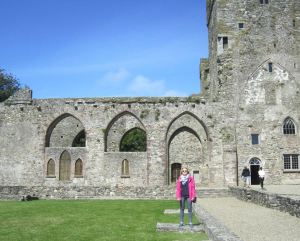
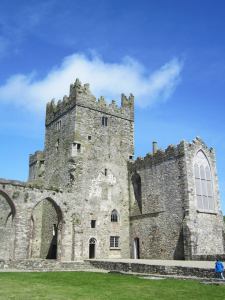 Tintern Abbey was founded in 1200 by Count William of Marshall and it got its name after the bigger namesake in Wales.
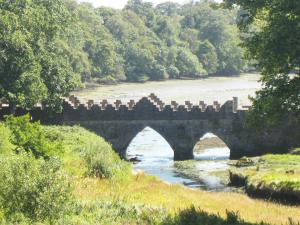 One of the vainest family members let to build such kind of a bridge, just only because its decorative and beautiful appearance. And especially decorative it looks seen through the upper window of the Abbey where our tour guide tells us stories about the Colclough family’s history. Yes, we are having a guided tour, so smart. The tour guide makes the place more alive, especially that she knows a lot about the characters and habits of every single person who has lived there.
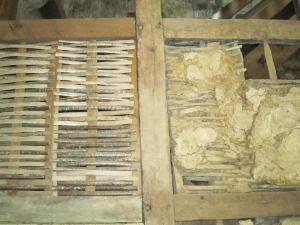 That’s how they built the walls during the old times – the blend between the lattice was made from so many different ingredients that the restoration workers of nowadays were not able to catch up on it. But at least they tried! And it’s possible to see the wall building process in different stages. The guide says that this filling made the walls warm keeping and let the stone breathe. Probably it will make sense for our school’s construction department 🙂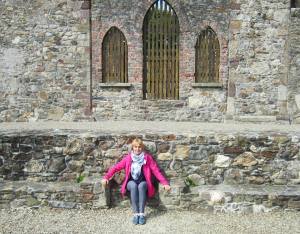
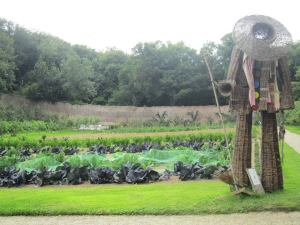 The little road that goes through the wood takes you to the Colclough Walled Gardens, which have been restored and trimmed recently and look quite nice. You need to buy a ticket again when entering the gardens, but I think they are collecting money for some more restoration work. The gardens are nice, full of flowers and there’s also an orchard part with vegetables and scarecrow which looks huge and decorative, probably not so decorative for the crows. In Estonia, we call these things not Scarecrows, but Scarepeas, instead, although they are meant to scare the crows, not the peas 🙂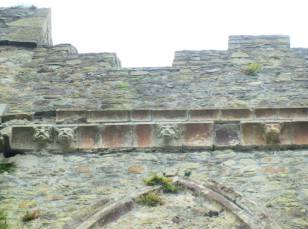



 Dublin Accent